The architecture of comfort: why the world’s most expensive tents are the future of glamping
When I first stepped into the world of high-end outdoor gear, I asked myself a simple question: can a portable shelter truly justify a price tag that rivals a pre-owned car? The answer didn’t come from a spec sheet, but from a night spent in a structure that felt less like a nylon bag and more like a mobile estate. Today’s luxury tents for glamping represent a massive shift in how we interact with the wilderness, moving away from “surviving” the elements toward thriving within them in a curated, climate-controlled environment.
Redefining the wild: why premium shelters are a long-term investment
To me, a high-end tent is essentially an investment in silence and psychological safety. While budget models often feel like thin raincoats that flap violently in the wind and trap condensation, premium shelters act like a thermal flask and a soundproofing booth combined. We utilize high-density fabrics with complex weaves, such as modern poly-cotton blends, which “breathe” to prevent stuffiness while remaining entirely waterproof through the natural expansion of fibers when wet. Think of it as a living organism; the material adapts to the environment, maintaining a consistent internal microclimate regardless of what is happening on the other side of the wall.
The technical depth of these structures is found in the details that remain invisible until the weather turns. For those looking for glamping tents canada, the requirements for thermal insulation and wind resistance are extreme. In these scenarios, it’s not just about fabric thickness, but the integrity of the seams – which are often heat-welded rather than just taped–and hardware that is over-engineered by 300% compared to standard gear. This ensures that your sanctuary doesn’t just survive a storm but remains a place where you can sleep soundly while the gale rages outside.
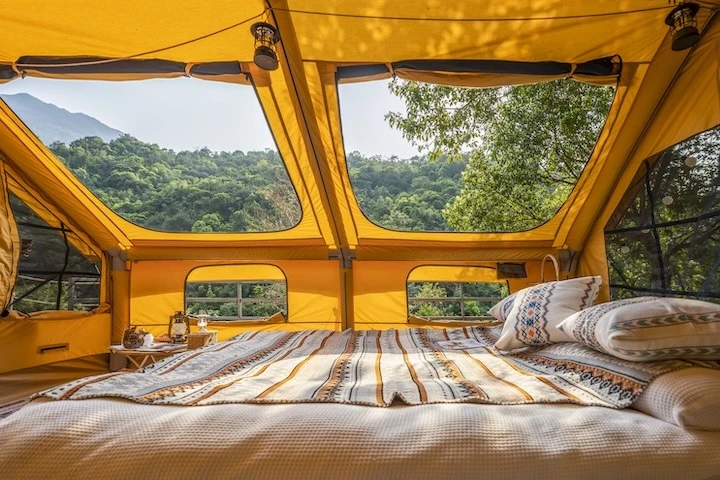
Inside a true luxury shelter, the design focuses on how a human actually moves. We eliminate the “tent crouch” by prioritizing vertical walls and cathedral-like ceilings, which is vital for long-term comfort. This is interior ergonomics applied to the outdoors: power ports, storage organizers, and lighting attachment points are placed exactly where your hand instinctively reaches. By integrating large glamping tent designs with panoramic windows, we turn the forest or the coastline into live wallpaper, merging the luxury of a boutique hotel with the raw beauty of the trailhead.
The engineering of invisible support: air frames and material science
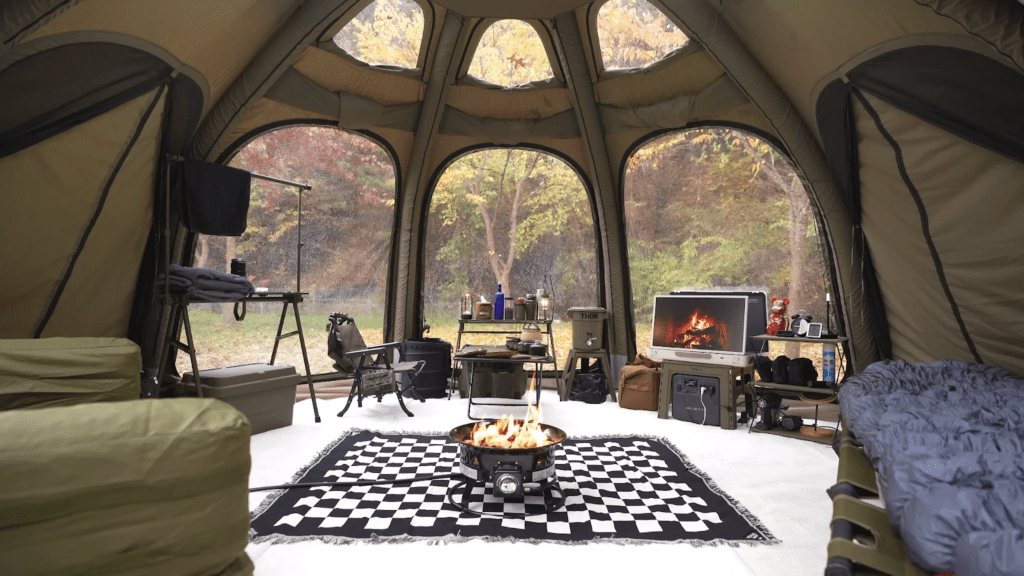
Historically, luxury camping was the domain of British safari-goers or military officers, requiring a small army of porters to lug heavy wooden poles and massive canvas sheets. Today, we’ve revolutionized this by replacing rigid skeletons with high-pressure air frame technology. An inflatable beam acts like a vehicle’s shock absorber; it absorbs the energy of a wind gust and snaps back into shape, whereas a traditional aluminum or fiberglass pole would likely snap or permanently deform under the same stress. This “soft” architecture provides a level of structural resilience that was once unthinkable in portable housing.
The future of these technologies lies in modularity and autonomy. I see the next generation of camping not as a single room, but as a “habitat network” where you can connect different modules for sleeping, working, and dining. It’s akin to building a space station on the forest floor; you customize the configuration based on your team size and mission duration. We are already seeing a trend toward heat-reflective coatings and advanced ventilation systems that use passive convection to keep the air fresh and cool without the need for noisy mechanical fans.
From a practical standpoint, the air frame eliminates the “human error” factor of assembly. You can’t put a pole in the wrong sleeve because there are no poles. This turns the chore of setting up camp into a five-minute ritual, freeing up your time for what actually matters: the experience. For the user, this means less time wrestling with instructions in the dark and more time enjoying the sunset. Technology, in its best form, should be a silent servant that facilitates peace of mind.
The practical masterclass: choosing your domain for the future
Selecting a high-end shelter should be based on your personal “life-outdoors” scenario rather than just the price. If you are a seasonal traveler who stays in one spot for a week, look for models with dedicated “mud rooms” or vestibules. Keeping the wet gear and dirt away from the sleeping area is a small detail that completely changes your daily mood. I also suggest checking the UV-resistance ratings of the fabric; cheap nylon degrades under the sun within a season or two, whereas technical fabrics are designed to be family heirlooms that last for decades of exposure.
For those who venture out in the “shoulder seasons” or early winter, the ability to safely heat the space is a game-changer. High-end models often include dedicated stove jacks or fire-resistant ports for heaters. My advice is to always look for multi-level ventilation; you need airflow at both the floor and the peak to move CO2 and moisture out of the tent while you sleep. This ensures you wake up feeling refreshed rather than groggy – a subtle but critical difference between a cheap night out and a luxury expedition.
Ultimately, the most expensive tent isn’t about status; it’s about the freedom to feel “at home” anywhere on the map. It’s about a shelter that forgives a beginner’s mistakes and meets a professional’s demands. I recommend viewing this purchase as you would real estate – focus on the quality of the “foundation,” the breathability of the “walls,” and the logic of the layout. High-quality gear eventually pays for itself by eliminating hotel costs and allowing you to wake up under the stars with the same restorative comfort as a five-star suite.